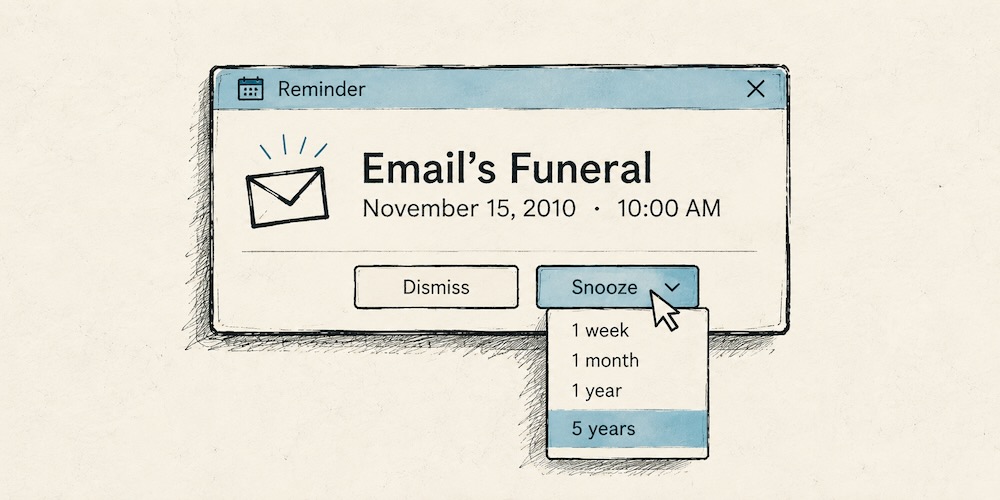
Email has been dying for most of my career.
In 2010, Facebook was preparing what was widely described as a “Gmail killer.” A few years later, Messenger was supposedly coming for email. Then Slack arrived, and TIME literally called it an “E-Mail Killer.” Slack certainly changed the way a lot of us work, and thankfully replaced some of the internal emails nobody wanted to receive in the first place. It did not, however, kill email. Neither did Facebook, Messenger, collaboration platforms, social media, or any of the other contenders. Now AI gets its turn.
That’s pretty consistent with the history of digital marketing. New channels don’t usually replace old ones. We just add them to the mix. Search didn’t eliminate display. Social didn’t eliminate search. TikTok didn’t eliminate YouTube. Every addition creates another place marketers are expected to show up, usually without a corresponding increase in budget or people. Worse, the content doesn’t necessarily travel well. A video that’s perfect for YouTube isn’t necessarily right for TikTok. An email can’t just be pasted into Instagram and expected to work.
I’ve been working in digital marketing for most of this supposed email death spiral. Email is still here. More importantly, it still works.
Traffic isn’t the same thing as engagement
Years ago, while leading digital marketing for a large global networking technology company, I started asking a question that sounds simple: Which of our digital channels actually worked?
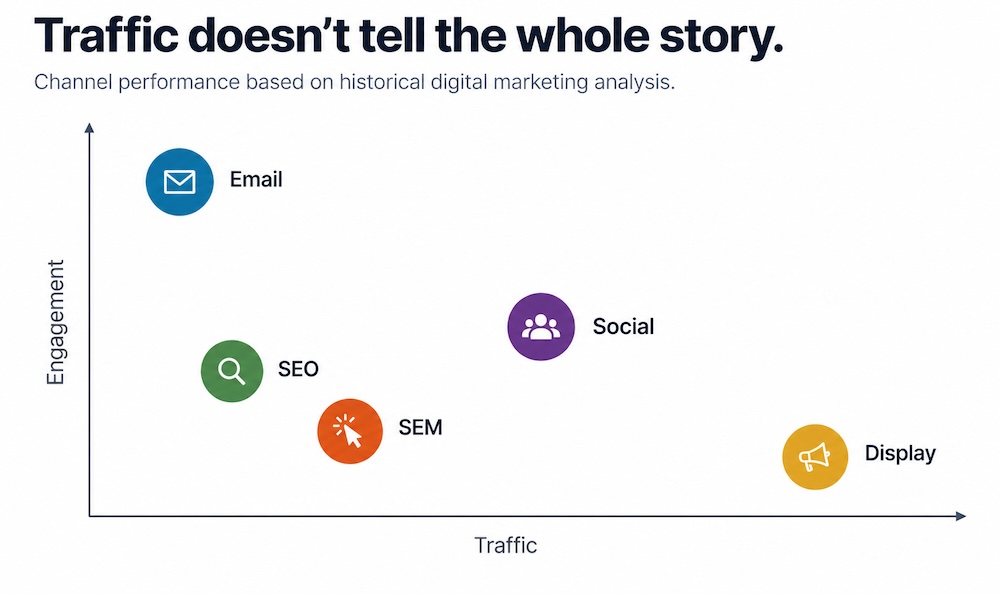
Traffic alone wasn’t a particularly satisfying answer. Search could deliver traffic. Display could deliver a lot of traffic. Social could introduce people to us. But getting someone to a website isn’t the same thing as getting that person to engage with the company once they arrive.
Using Adobe Analytics, we started looking beyond visits at behaviors that suggested someone was actually interested in what they found. Across those measures, email consistently punched above its weight. It wasn’t our largest source of traffic, but visitors arriving from email were among our most engaged.
That makes sense when you consider what had happened before they clicked: they had already asked to hear from us.
Market to people who want you to market to them
Marketing works better when you market to people who want you to market to them. Profound, I know.
And yet an extraordinary amount of marketing technology and effort is devoted to finding more people, buying more names, building bigger audiences, retargeting them, following them around the internet, and creating increasingly elaborate sequences to persuade them to pay attention.
Meanwhile, someone who voluntarily gives you an email address has done something remarkably useful: they’ve given you permission to continue the conversation.
That permission comes with obligations. At the networking company, we used frequency caps because the recipient didn’t care that three different business units all considered their message important that week. If we allowed that, we would just be yet another company sending too much email.
The same principle extends beyond marketing. A customer doesn’t necessarily distinguish between the newsletter Marketing sent Tuesday and the seven technology alerts another part of the company sent Wednesday. They experience one company in one inbox. Marketing may not control every operational communication, but somebody should understand the cumulative experience you’re creating.
Segmentation helps, too, until the incremental relevance of another tiny audience stops justifying the operational complexity required to maintain it. That’s a subject worthy of its own article.
A healthy email relationship also usually starts somewhere else. Someone finds you through search. Sees something on social. Watches a video. Attends an event. Reads an article. Walks into a store. The job of those experiences isn’t simply to produce another pageview. One of the best outcomes is earning permission for another interaction.
A newsletter signup may be the purest version of that. No white paper being held hostage. No webinar registration required. Just: I like what I’m seeing. Show me more.
An email address isn’t the asset
An email address by itself isn’t particularly valuable. A database of people who have voluntarily asked to hear from you is.
There’s an important distinction there.
Paid media can be excellent for creating awareness and reaching people who don’t know you yet. Search, social, sponsorships, publishers, events, and useful content can all introduce your business to new audiences. But when those interactions produce an opt-in, you’ve created something different: a direct relationship you don’t have to rent again every time you want to communicate.
Of course, that relationship is remarkably easy to destroy. Send too often. Send things that aren’t relevant. Treat everyone exactly the same. Or buy a spreadsheet full of addresses and pretend those people have a relationship with you.
If I need access to a new audience, I’d much rather buy access to the audience than buy the audience itself. Sponsor something. Advertise. Show up in search or social. Work with a publisher. Create something useful. Then earn the right to keep talking.
Email doesn’t work by itself
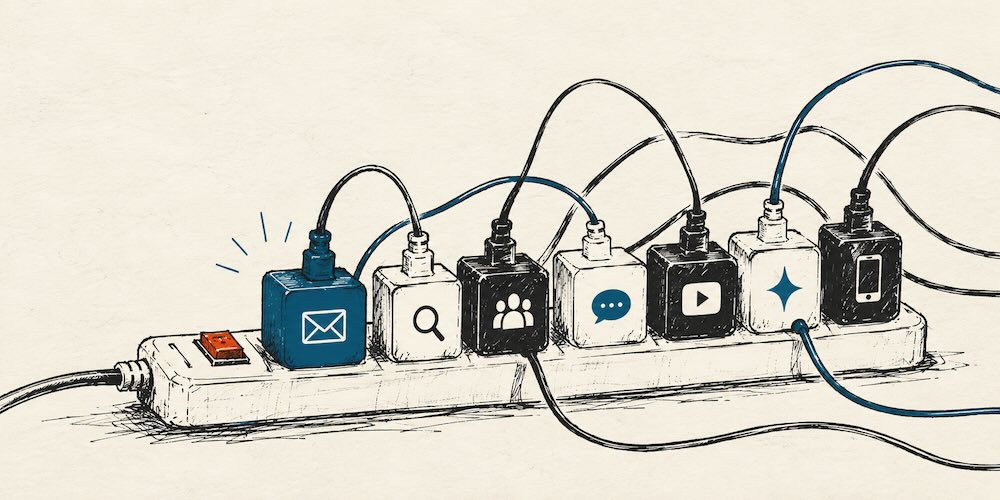
The proliferation of channels makes orchestration more important, not less.
People are surrounded by messages. Adding more noise isn’t a strategy. The channels should reinforce one another.
Someone might first encounter your company through social, see a display ad later, receive an email because they’ve previously opted in, and finally search for you when they’re ready to act. The actual customer journey rarely resembles the clean little attribution path we put into PowerPoint.
Email’s role in that journey doesn’t have to be introducing the idea. Often, its value is helping the idea stick.
That’s also why engagement matters. Traffic tells you where somebody came from. Engagement begins to tell you whether what you’re doing is actually resonating, and where your next marketing dollar or hour might be better spent.
So why isn’t email dead?
The technologies that were supposed to kill email weren’t failures. Slack is better than a 37-reply internal email thread. Project management tools are better for managing projects. Search, social, display, video, messaging, and now AI all do jobs email doesn’t.
Email survived because it occupies a useful role in the relationship.
Other channels can help people discover you. Good marketing can earn their attention. Great marketing can earn their permission.
Email is still one of the best ways we have to use that permission.
We’re seeing another version of this question in work we’re doing today with a luxury retailer. The interesting question isn’t simply whether somebody opened an email or clicked a product. It’s whether email influenced what happened next, including purchases that ultimately occurred in a physical store. That’s considerably harder to measure. It’s also considerably closer to the business question that actually matters.
After all these years of trying to kill email, maybe we’ve been asking the wrong question. Instead of asking what new channel will finally replace it, marketers should be asking what role each channel plays, how those channels work together, and which ones are actually creating meaningful engagement.
Email doesn’t need to win every comparison. It just needs to keep earning its place in the mix.
So far, it has.